

Defensible space in California: what the law requires, zone by zone
 By Michael Schuck, ISA Certified Arborist WE-15750A · Updated 2026-10-20
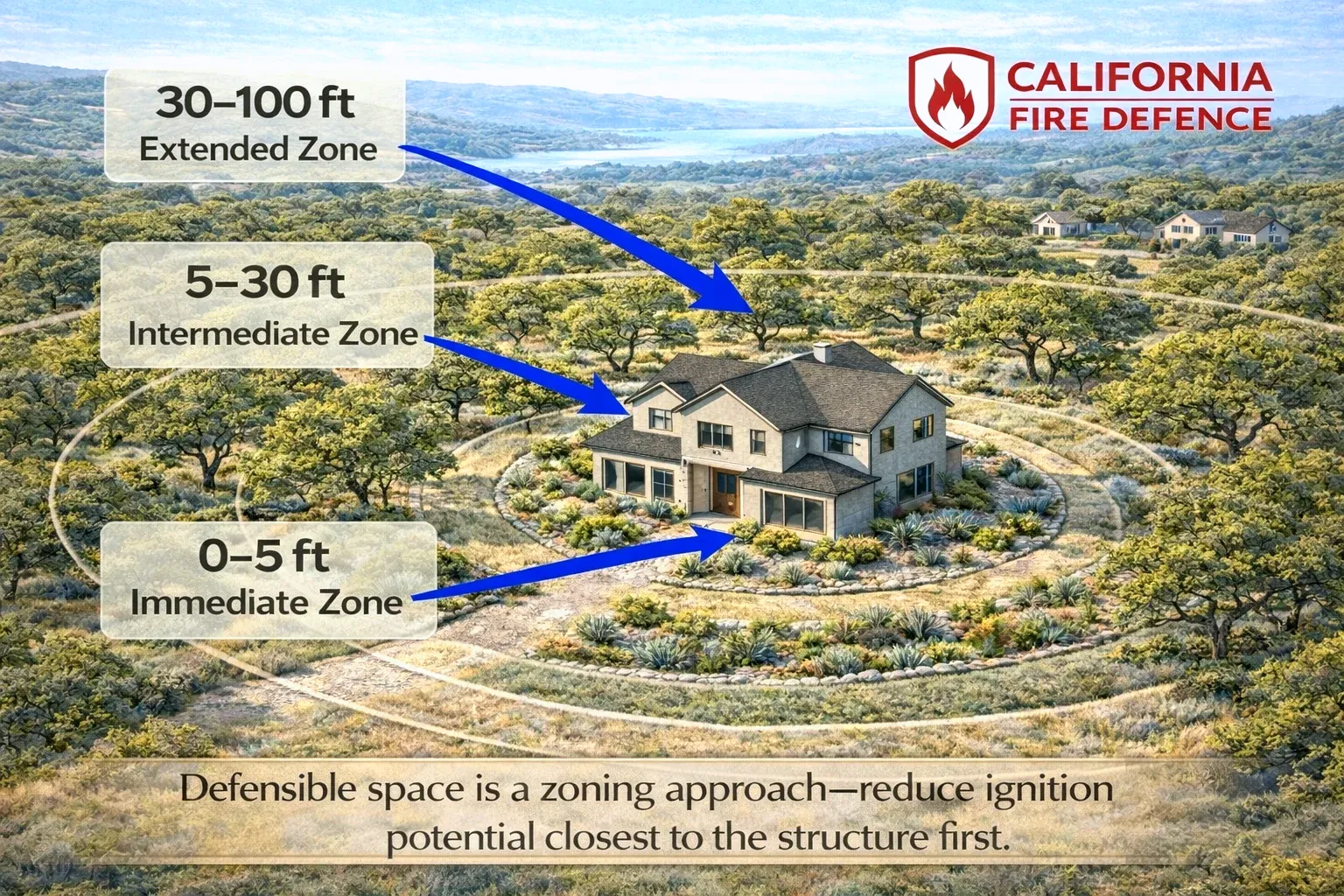
Which law applies to you
- State Responsibility Area (SRA): CAL FIRE's jurisdiction, mostly unincorporated land. PRC §4291 applies and CAL FIRE or a contracting local agency inspects. In the Bay Area: parts of unincorporated Marin, Contra Costa, San Mateo, Santa Clara, and most of the Santa Cruz Mountains.
- Local Responsibility Area (LRA), Very High Fire Hazard Severity Zone: Government Code §51182, same 100-foot standard, enforced by the city or district fire department. The 2025 state maps (released for the Bay Area on February 24, 2025) expanded Very High and High zones in many cities; each city had to adopt the designation by ordinance within 120 days and may make it stricter but not weaker.
- Local ordinances: Oakland, Berkeley, the Marin fire districts, Woodside Fire, and others apply their own vegetation standards, often district-wide regardless of zone, with annual inspections. These are the rules you'll actually be inspected against; the state law is the floor.
Find your zone on the OSFM LRA map viewer or the SRA viewer. Your location page names the agency that inspects you.
Zone 0 — 0 to 5 feet: the ember-resistant zone
Created by AB 3074 (2020). The Board of Forestry adopted regulations on August 19, 2026 and withdrew them from the Office of Administrative Law on September 8, 2026; as of this writing nothing has been refiled and the Board's own page still describes the rule as under review. CAL FIRE's guidance says plainly that Zone 0 is "not legally required yet." Treat it as the standard your insurer and inspector expect anyway, because it is what the withdrawn text, CAL FIRE's Zone 0 At-A-Glance, and the Safer from Wildfires insurance items all describe:
- No combustible mulch (bark, wood chips), leaves, needles, or debris. Gravel, pavers, concrete, bare soil.
- Nothing stored under decks or stairs; no firewood.
- No vegetation under the eaves, within 1 foot of a wall without an eave, within 2 feet of windows, doors, or vents, or within 5 feet of an attached deck.
- Trees may stay, but: no dead branches; no live branches under the eaves; live branches at least 10 feet from a chimney outlet, 5 feet above the roof, and limbed up 6 feet (or the lower third of the tree, whichever is less).
- No combustible fence or gate attached to the house; a 5-foot noncombustible section where a fence meets the structure.
- Short non-woody plants (under 3 inches — lawn, groundcover) are allowed; small spaced plantings and potted plants in noncombustible pots have narrow allowances.
Full draft text, phase-in schedule, and what's likely to change: Zone 0 guide →
Zone 1 — 5 to 30 feet: "lean, clean, and green"
This is where the statute's "more intense fuel reductions" language applies and where inspectors spend their time. Requirements from §4291, the SRA regulations (14 CCR §1299.03), and CAL FIRE guidance:
- Remove dead plants, grass, and weeds. Remove dead and dying branches overhanging the roof and near windows and walls.
- Remove any portion of a tree within 10 feet of a chimney or stovepipe outlet — this one is in the statute itself.
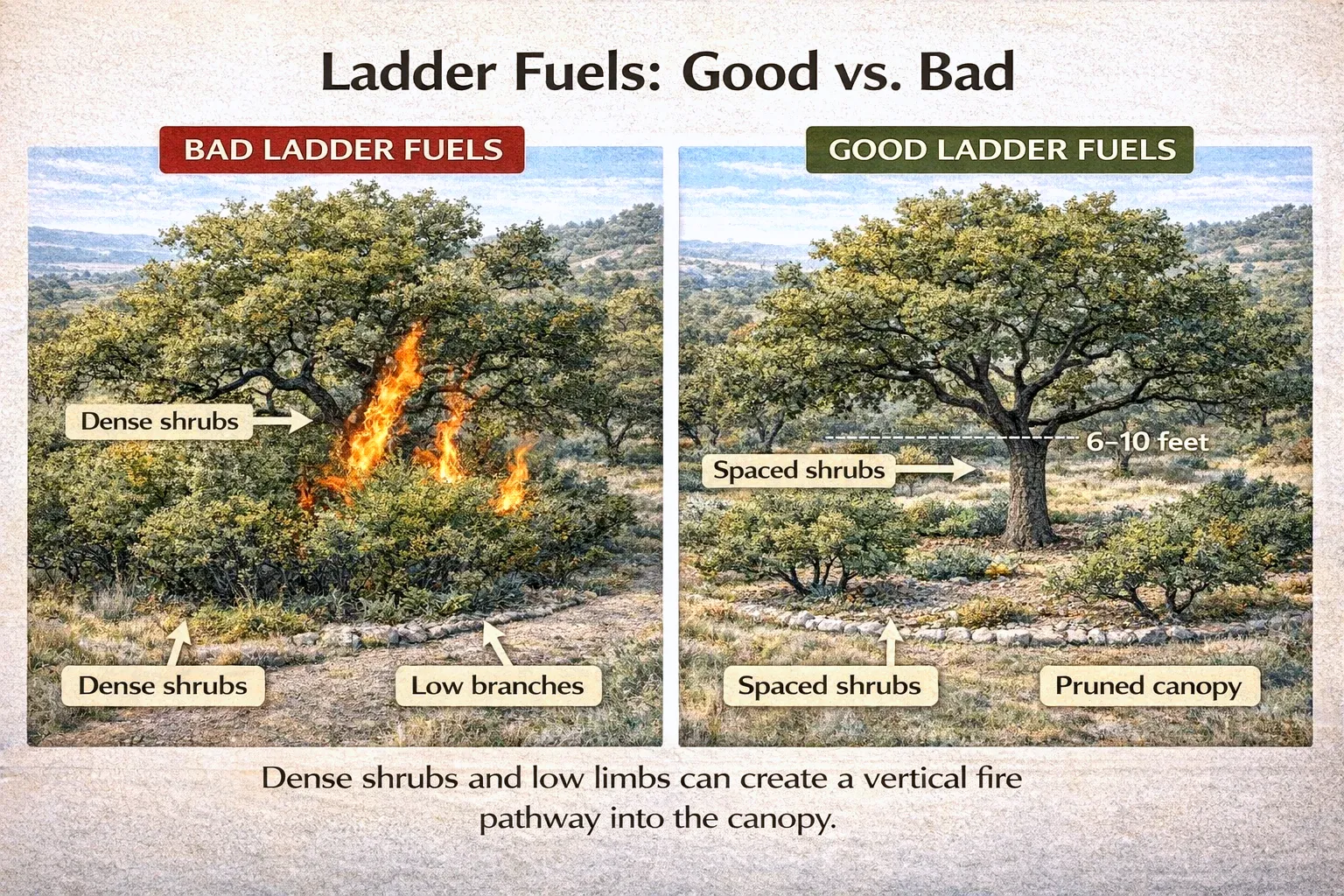
- Break up ladder fuels: shrubs under trees are the single most common failure. Vertical clearance between the top of a shrub and the lowest branch should be three times the shrub's height.
- Limb trees up 6 feet from the ground (or one-third of height on small trees).
- Separate shrub groups; keep plantings in islands rather than continuous beds.
- Move firewood and lumber out to Zone 2, or cover and clear 10 feet around it.
Zone 2 — 30 to 100 feet: the reduced-fuel zone
- Annual grass cut to 4 inches or less.
- Surface litter (leaves, needles, bark) kept to a depth of 3 inches or less.
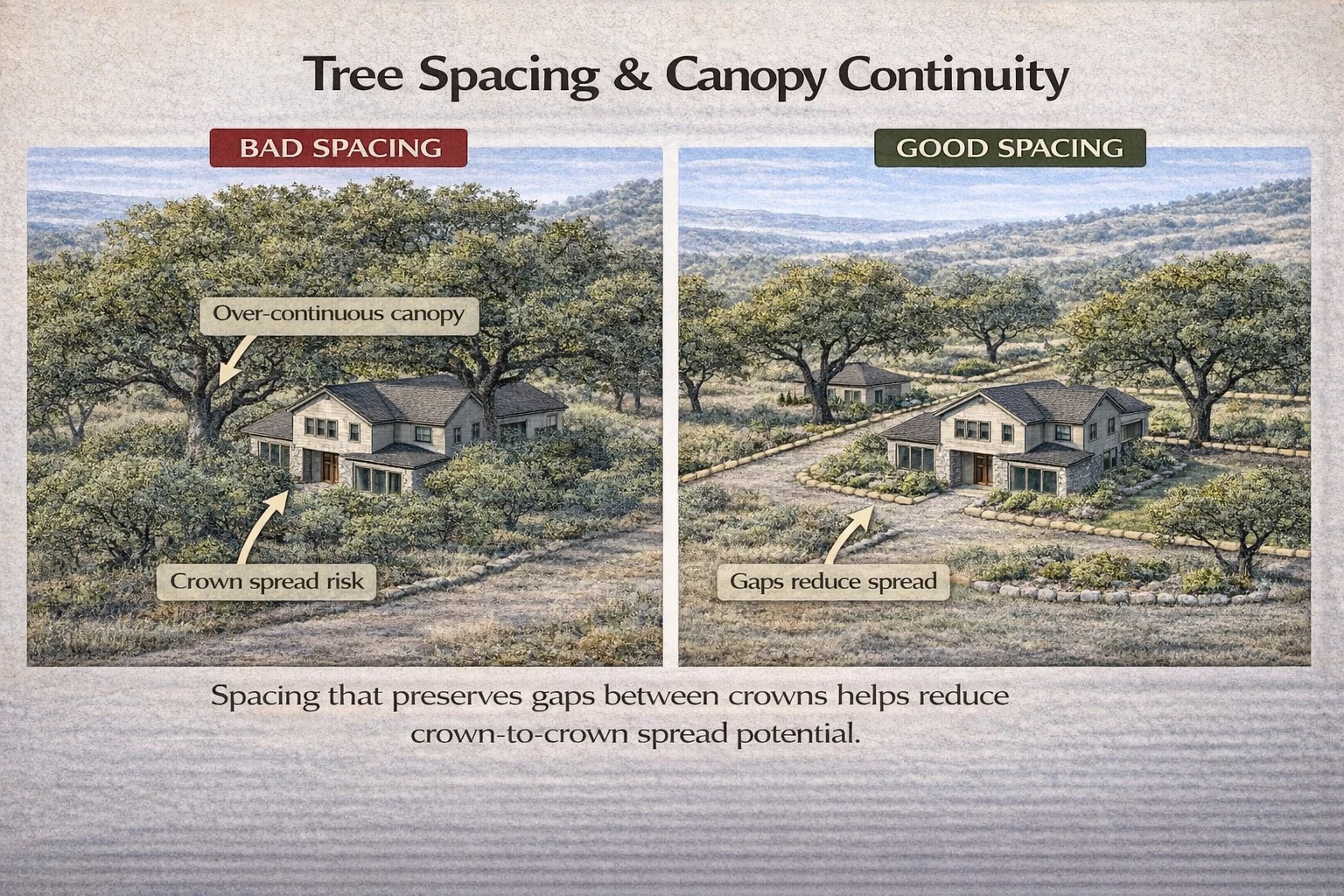
- Horizontal spacing between tree crowns: 10 feet on slopes under 20%, 20 feet on 20–40% slopes, 30 feet above 40%. Shrubs: two, four, and six times the shrub's height respectively.
- Dead trees removed; dead limbs removed; ladder fuels managed the same way as Zone 1.
- 10 feet of clearance around woodpiles, outbuildings, and LPG tanks.
The trees: what the law says and what it doesn't
Three things are in the statute: 10 feet from a chimney, no dead or dying wood on trees adjacent to or over the building, and a roof free of leaves and needles. Everything else — limb-up heights, crown spacing, canopy over the roof — is regulation or guidance, and local ordinances vary. Two consequences:
- Most tree compliance is pruning, not removal. Deadwooding, limbing up, clearing the chimney, lifting branches off the roof. In most Bay Area cities routine pruning to these standards does not need a permit; heavy pruning (more than a quarter of the canopy, or topping) sometimes does.
- Removal still needs the city's permission. Fire safety is a reason the city will consider, not an exemption, in Oakland, Berkeley, the Marin towns, the Peninsula hill towns, Saratoga, and Los Gatos. Some cities have expedited or exempt paths for dead or hazardous trees; a few have none. The permits guide covers this city by city.
Where this goes wrong
A landscaper clears 100 feet to bare dirt, removes a protected oak without a permit, and the homeowner gets a fine from the city and an erosion problem on the slope. Or the opposite: a homeowner leaves the dead Monterey pine over the roof because "the city won't let me," when a dead tree is exempt almost everywhere. A written plan from someone who knows both rule sets avoids both.
How inspections work in the Bay Area
- Who: your local fire department in the LRA — Oakland's Vegetation Management Unit, Berkeley Fire, the Marin districts (coordinated by the Marin Wildfire Prevention Authority), Woodside Fire, Santa Clara County Fire, and so on. CAL FIRE in the SRA.
- When: most Bay Area programs inspect annually in late spring and early summer, with a compliance deadline before peak season and re-inspections after.
- What happens on failure: a notice with a correction deadline (45 days in Oakland; up to 12 months under Woodside Fire's assessment program); a re-inspection; then escalation that varies by agency — administrative fines, abatement by the agency with the cost billed to you, or a lien. §4291 violations are also a misdemeanor, though that's rarely the path.
- On sale (AB 38): in High and Very High zones the seller provides inspection documentation from the prior six months, or the buyer agrees in writing to comply within a year.
Each location page has the agency's inspection standard, season, and fee where published.
A seasonal rhythm that holds
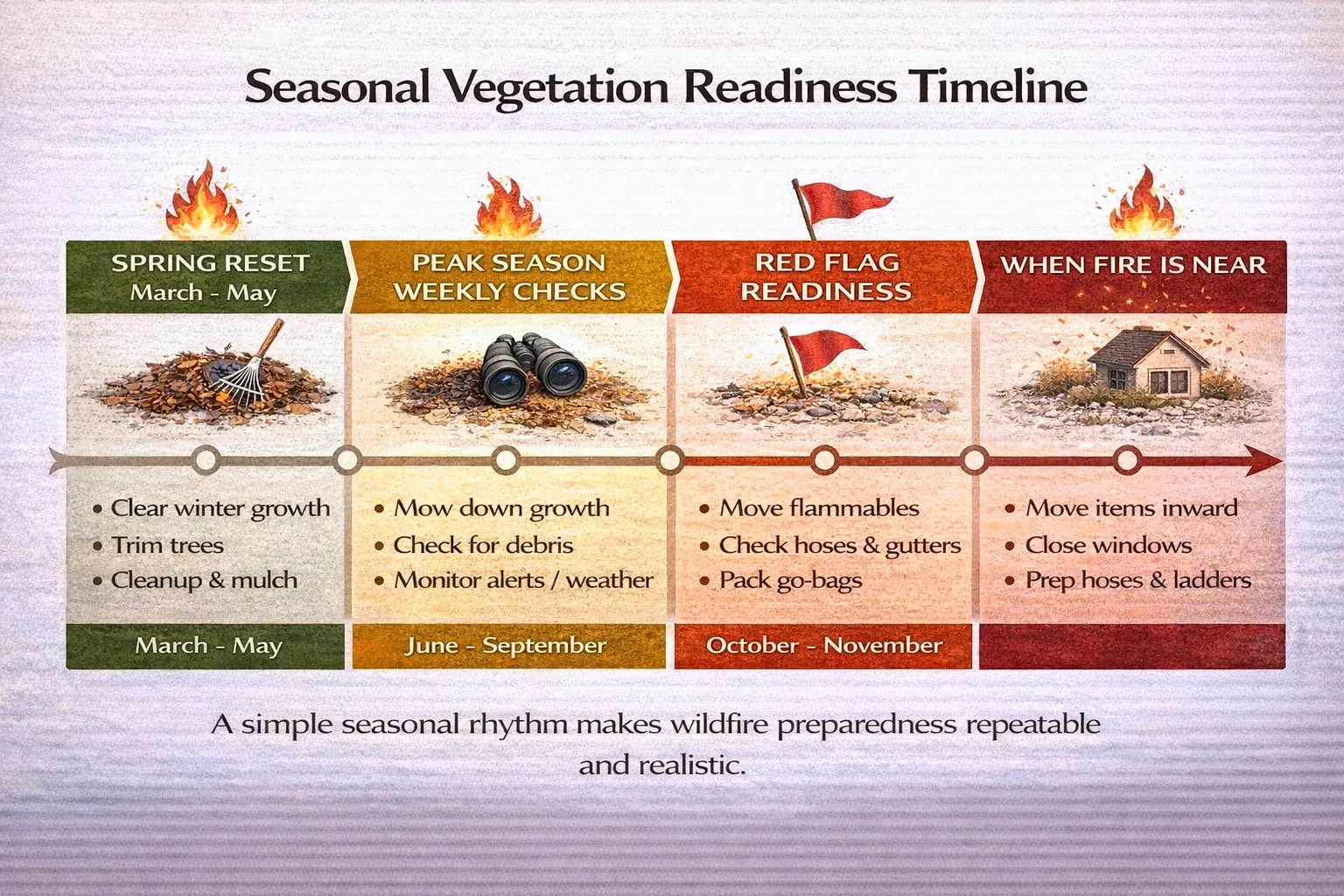
- March–May: the big cleanup. Mow before grass cures, prune, deadwood, replace mulch in Zone 0, clear gutters. This is when to schedule tree work so permits clear before inspection season.
- June–September: weekly walk of Zones 0 and 1. Grass regrowth, leaf and needle drop, anything that's accumulated against the house.
- October–November: Diablo-wind season. Gutters and roof again; move anything combustible inward on Red Flag days.
- December–February: plan next year's tree work and file any permits — city timelines run 4–12 weeks.
Where a consulting arborist fits
Fire agencies inspect for free and will tell you what fails. What they won't do is write the plan that tells a contractor exactly what to cut, flag which trees need a city permit, and give an insurer a professional's statement of conditions. That's the Defensible Space Plan, $850, or a $375 site consultation if you want the priorities verbally.
Sources
- AB 3074 (2020) chaptered text, including PRC §4291 as amended — Board of Forestry
- Board of Forestry — Defensible Space Zones 0, 1 and 2 (rulemaking status)
- Office of Administrative Law — recent actions on emergency regulations (file 2026-0828-03E withdrawn Sept 8, 2026)
- CAL FIRE — Defensible Space
- Ready for Wildfire — Defensible Space
- CAL FIRE — Zone 0 At-A-Glance
- OSFM — Fire Hazard Severity Zones (2025 LRA maps)
- OSFM Information Bulletin 21-007 — AB 38 defensible space documentation on sale
- Woodside Fire Protection District — AB 38 inspections
Questions we get
Is 100 feet of defensible space required in the Bay Area?
If your home is in a State Responsibility Area, yes, under PRC §4291. If it's in a city or county fire district (Local Responsibility Area) and mapped as a Very High Fire Hazard Severity Zone, yes, under Government Code §51182. Many Bay Area cities and districts — Oakland, Berkeley, Marin's districts, Woodside — also have their own ordinances that apply in High zones or district-wide. The requirement stops at your property line.
Who inspects my property?
CAL FIRE in the State Responsibility Area; your city or district fire department in the Local Responsibility Area. In the Bay Area that's almost always the local department — Oakland's Vegetation Management Unit, Berkeley Fire, the Marin districts, Woodside Fire, and so on. Each publishes its own standard; see your location page.
Do I have to remove trees?
The statute does not require tree removal. It requires removing any part of a tree within 10 feet of a chimney outlet, keeping trees adjacent to or over a structure free of dead and dying wood, and managing ladder fuels and spacing so fire can't climb or jump. Most tree problems are solved by pruning. Removal becomes the answer for dead trees, high-hazard species against the house, and canopies that can't be separated — and in most Bay Area cities that needs a permit.
What is Zone 0?
The 0–5 ft ember-resistant zone created by AB 3074 in 2020. The Board of Forestry adopted regulations for it on August 19, 2026, then withdrew them from the Office of Administrative Law on September 8. As of October 2026 Zone 0 is guidance, not an enforceable state rule. The draft text is in our Zone 0 guide.
I'm selling my house. What's the AB 38 inspection?
If the property is in a High or Very High Fire Hazard Severity Zone, the seller must give the buyer documentation of defensible space compliance from an inspection within the prior six months (Civil Code §1102.19). Your local fire agency does the inspection; some charge a fee (Woodside Fire: $498). If it can't be done before close, the buyer agrees in writing to comply within a year.
How is defensible space measured on a slope?
Horizontally from the structure, not along the ground. Spacing requirements increase with slope: CAL FIRE's guidance is 10 feet between tree crowns on flat ground, 20 feet on 20–40% slopes, and 30 feet above 40%.