

Wildfire insurance non-renewal: what the vegetation side actually requires
 By Michael Schuck, ISA Certified Arborist WE-15750A · Updated 2026-10-20
What's actually happening in 2026
Non-renewals in the Bay Area hills aren't a moratorium situation; they're a pricing-and-risk-score situation. The state's Sustainable Insurance Strategy let carriers use catastrophe models and pass reinsurance costs through to rates starting December 2024, and in exchange a dozen insurer groups have committed to write more policies in high-risk ZIP codes. Farmers joined that list in May 2026 with a pledge to market to at least 300,000 policyholders in distressed areas; Mercury, CSAA, USAA, Travelers, and others are on the CDI's list as committed or pending.
What that means for a homeowner in Mill Valley, the Oakland hills, or Woodside: the carriers coming back are the ones pricing by model, and the models reward documented mitigation. The FAIR Plan grew to roughly 697,000 policies by mid-2026 but its growth has slowed as carriers return. Your leverage is the mitigation file.
The vegetation items insurers are required to credit
Since October 2022, 10 CCR §2644.9 has required every insurer that rates on wildfire risk to give a discount for each of these "immediate surroundings" items. These are the regulation's words, lightly condensed:
- Vegetation and debris cleared from under decks.
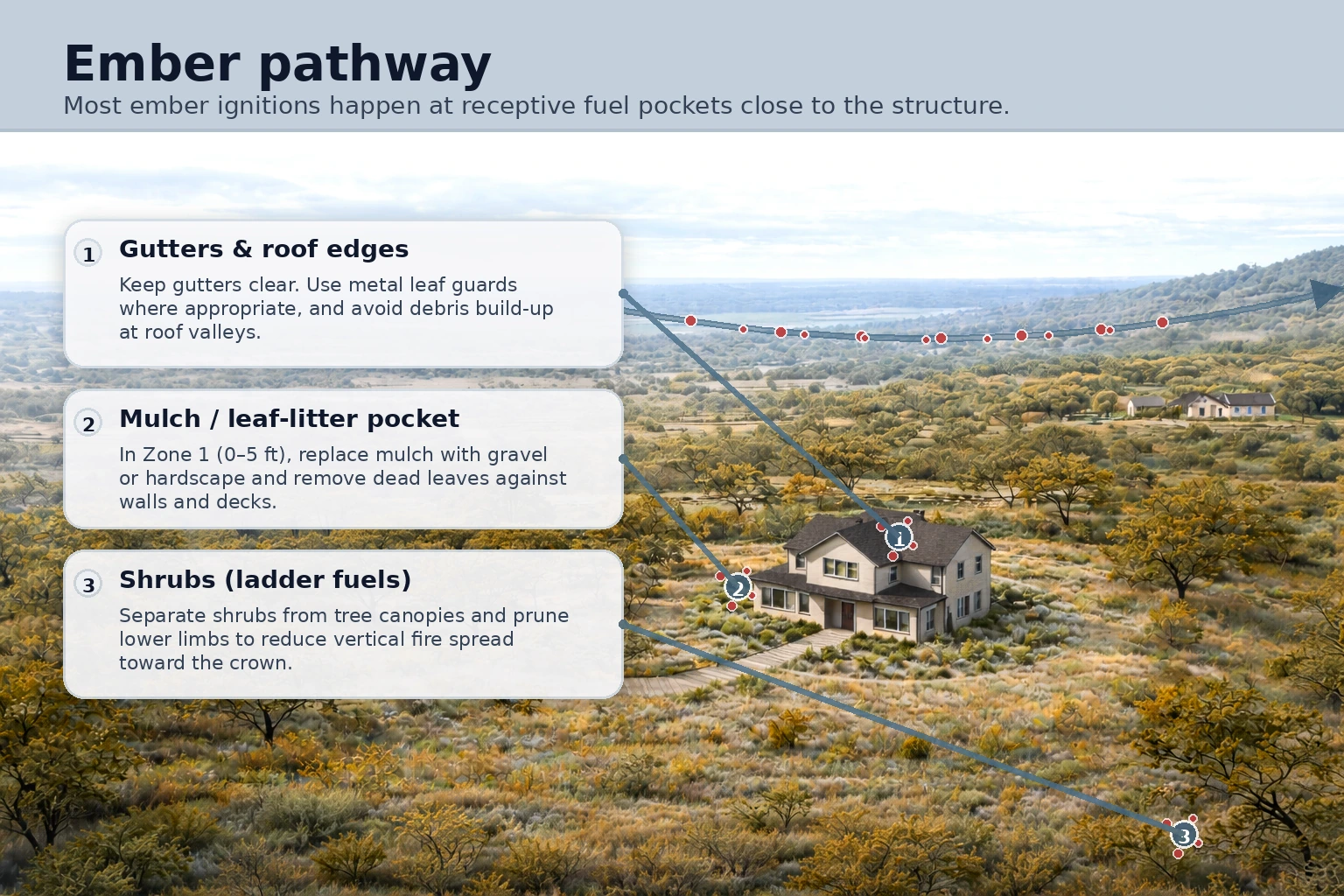
- Vegetation, debris, mulch, and stored or movable combustibles cleared within 5 feet of the building.
- Only noncombustible fences and gates within 5 feet of the building.
- No combustible sheds or outbuildings within 30 feet of the building (or as far as the insured controls).
- Compliance with Public Resources Code §4291 and any local defensible-space ordinance.
Plus the structure items — Class A roof, enclosed eaves, ember-resistant vents, multi-pane windows, 6 inches of noncombustible clearance at the base of walls — and two community items (a Firewise USA site in good standing, or a Board of Forestry–listed Fire Risk Reduction Community). Each item must carry its own discount. The CDI's March 2026 briefing put total discounts at 4%–40%, largest for the highest-risk homes.
What inspectors look for beyond the regulation
The regulation is the floor. Carrier inspections and the forms they use go further on trees. CSAA's California Wildfire Mitigation Verification Form tracks the regulation item by item and must be signed by a qualified inspection professional, not the homeowner. Industry practice on top of that, consistent across brokers and inspection vendors even where carriers don't publish a list:
- No branches within 10 feet of the roofline or chimney outlet
- Roughly 10 feet of crown separation between trees in the 5–30 ft zone, more on slopes
- No ladder fuels — shrubs or low limbs that carry fire from the ground into the canopy
- Dead trees and dead limbs removed
- Photos at underwriting and at renewal; some carriers re-verify annually
The state's Zone 0 regulation — adopted by the Board of Forestry on August 19, 2026, then withdrawn from the Office of Administrative Law on September 8 and not yet refiled — would codify much of this for Very High Fire Hazard Severity Zones: no live branches within 10 feet of a chimney, nothing under the eaves, limbs raised 6 feet, branches 5 feet above the roof, and a phased timeline for existing homes. It is not law today. But the draft is the standard insurers are reading, and the vegetation items in it are what a carrier inspector means by "defensible space." See the Zone 0 guide for the actual text and status.
The protected-tree problem
This is the part that gets Bay Area homeowners stuck. The carrier wants the coast live oak over the roof gone or cut back 10 feet. The city protects the oak and requires a permit, an arborist report, and sometimes replacement trees. Both are right. The way through is usually pruning to clearance under the city's standard (which often doesn't need a removal permit, though some cities permit major pruning too), documented by an arborist so the insurer sees a professional judgment rather than a refusal. Where removal is justified on fire-hazard grounds, the arborist report is what the city needs to approve it. The permits guide covers this city by city.
IBHS Wildfire Prepared Home is stricter
If you're pursuing the IBHS designation (Essential or Enhanced tiers; $125 fee; recognized by Mercury, State Farm, and CSAA in California), Zone 0 must be fully noncombustible with no plants at all, and a protected tree inside 5 feet that can't be removed can make the home ineligible. Decide which standard you're building to before you start.
What to do after a non-renewal notice, in order
- Read the notice for the date and the reason. Count back 75 days from expiration. If the notice is short, the policy continues for 75 days from receipt.
- Check for a moratorium. CDI posts a bulletin per declared fire with the covered ZIP codes. None cover Bay Area counties as of October 2026, but check — a covered ZIP means the insurer must offer to rescind the non-renewal.
- Request your risk score and the itemized discounts in writing. You're entitled to both under §2644.9(k). This tells you exactly which items the carrier thinks you're missing.
- Do the vegetation items and document them. Dated before-and-after photos of each item, invoices, and a professional statement. If trees are involved, get the arborist's letter before the work so the permit and the insurer file line up.
- Appeal. Written request with the file. Acknowledgment in 10 days, decision in 30. Parallel-shop with an independent broker using the CDI Home Insurance Finder, filtered to insurers writing in higher-risk areas.
- If nothing binds in time, FAIR Plan plus a DIC policy. Bind before expiration to avoid force-placed coverage from your lender. The FAIR Plan covers fire and a few named perils; the Difference in Conditions policy from a standard carrier adds liability, water, theft, and loss of use. Apply for the FAIR Plan mitigation discounts through the broker's attestation form.
- Complain if the timelines slip. CDI Consumer Hotline 800-927-4357.
Where a consulting arborist fits
We don't sell insurance, inspect for IBHS, or do the tree work. What we do is produce the vegetation half of the file: an arborist letter on letterhead stating conditions by zone and the work scoped or completed, a dated and labeled photo record, a checklist mapped to the §2644.9 items and the carrier's own form, and — where a protected tree is the sticking point — the arborist report the city needs. That's the Insurance Documentation Package, $650, with a $250 re-inspection letter once the work is done. If you just want someone to read the carrier's letter and your photos first, a desk review is $250.
Sources
- 10 CCR §2644.9 — Mitigation in rating plans and wildfire risk models
- CDI — Safer from Wildfires
- CDI — FAQ on the mitigation regulation (rev. Sept 4, 2026)
- Insurance Code §678 — notice of non-renewal
- CDI — Sustainable Insurance Strategy (updated Oct 7, 2026)
- CDI — Farmers commitment to distressed areas (May 2026)
- CDI — Wildfire safety and insurability briefing (Mar 27, 2026)
- California FAIR Plan — mitigation discounts effective Nov 15, 2025
- CDI — FAIR Plan commercial limits (Mar 2025)
- CSAA — California Wildfire Mitigation Verification Form (June 2026)
- IBHS — Wildfire Prepared Home FAQ
- Board of Forestry — Defensible Space Zones 0, 1 and 2
- Office of Administrative Law — recent actions on emergency regulations (Zone 0 file 2026-0828-03E withdrawn Sept 8, 2026)
Questions we get
My insurer non-renewed me. How much notice are they required to give?
At least 75 days before the policy expires, in writing, with the reason stated and your right to have the Department of Insurance review it (Insurance Code §678). If the notice is late, the policy continues unchanged for 75 days.
Can I make them tell me my wildfire risk score?
Yes. Under 10 CCR §2644.9 the insurer must give you the score or classification in writing — at least 75 days before a non-renewal, 45 days before a renewal, and within 30 days if you ask after doing mitigation work. The notice has to list each mitigation item you haven't done and the dollar discount it would earn.
How do I appeal the score after I clear my Zone 0 and prune the trees?
Send the insurer (or your agent, who must forward it within 5 days) a written request with your documentation. They must acknowledge within 10 calendar days and decide in writing within 30. If they don't, that's a complaint to the CDI hotline, 800-927-4357.
Is there a moratorium on non-renewals in the Bay Area?
As of October 2026, no. Moratoriums under Insurance Code §675.1 are tied to a specific declared fire and cover ZIP codes in or next to its perimeter for one year. The active ones are in Los Angeles, Calaveras, Tuolumne, Mono, San Luis Obispo, and Santa Barbara counties. Check the CDI bulletin page for your ZIP before assuming.
Does an arborist letter satisfy the insurer?
The regulation says insurers must accept a CAL FIRE or fire-department inspection as proof and may accept other verification; it doesn't name arborists one way or the other. In practice, carriers want dated photos plus a professional's statement of what was done. CSAA's form, for example, must be completed by a qualified wildfire inspection professional, not the homeowner. Our package is built to be that professional statement and photo record. We don't promise a carrier's decision.
What about the FAIR Plan? Is there a discount?
Yes, since November 15, 2025. Up to 12 discounts on the wildfire portion of the premium, capped at 16.4% on dwelling-fire policies, for the same property items as Safer from Wildfires plus a bonus when all ten are done. Applied through your broker's attestation; the FAIR Plan may inspect afterward.