

HOAs · Condo associations · Property managers · Campuses
A wildfire vegetation plan the board can vote on
One assessment of the whole community, a mapped priority list, a phased scope contractors can bid, and the documentation the association's insurer and the fire district want to see. $2,500–4,500 depending on acreage and tree count.
What the plan includes
Community fuel assessment
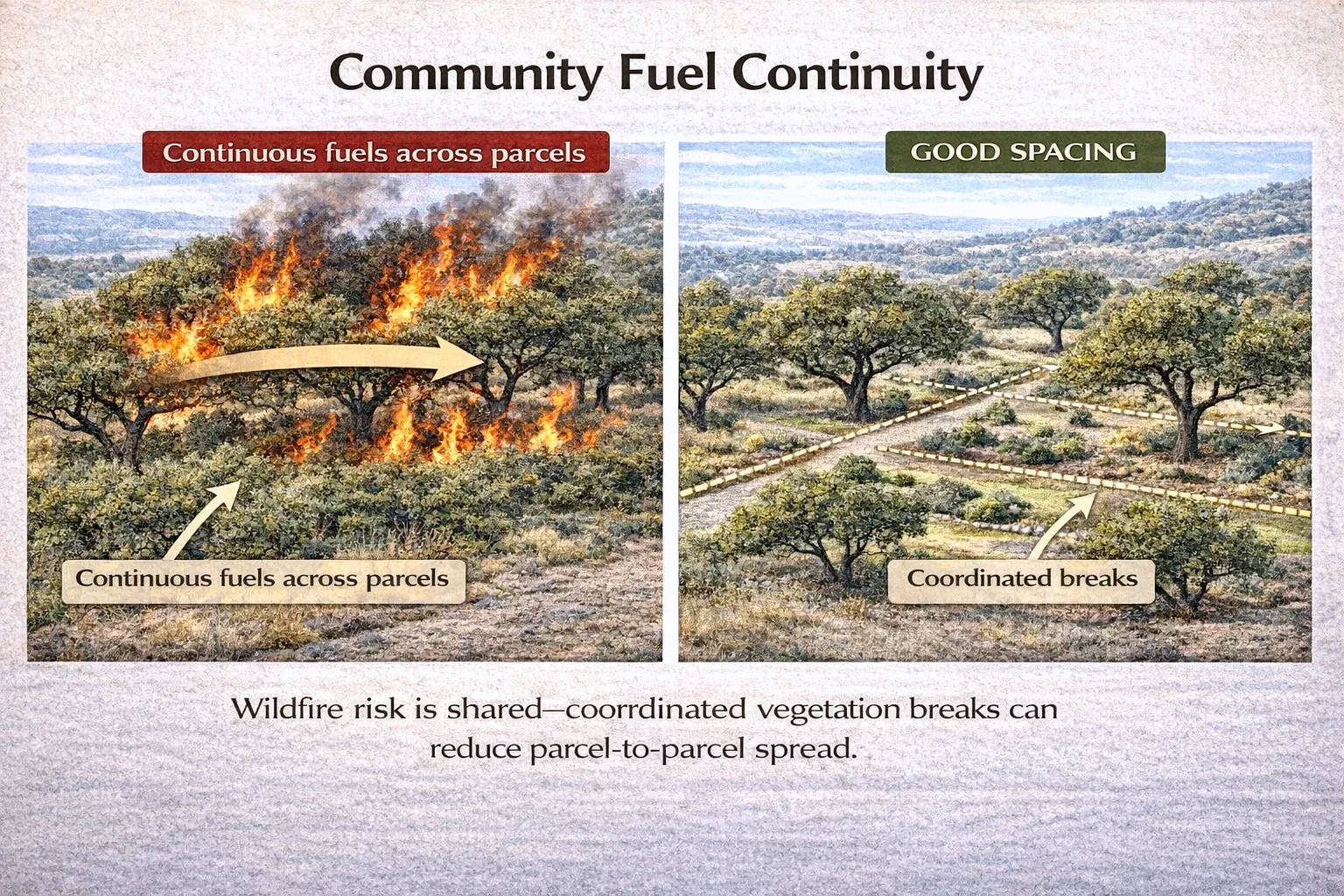
Common areas, slopes, greenbelts, perimeter edges, and the 0–30 ft around every building, walked and photographed. Ladder fuels, canopy continuity, dead and dying trees, high-hazard species.
Mapped priorities
A site map with numbered work zones ranked by ignition risk to structures and evacuation routes, so the board funds the right $20,000 first.
Tree inventory for the risk trees
Species, size, condition, recommended action, and whether a city permit is required — for every tree flagged, not every tree on the property.
Phased scope
Year 1, 2, and 3 scopes written so a landscape or tree contractor can bid line by line. We don't bid it ourselves, so there's no conflict in putting it out.
Permit and ordinance roadmap
Which cities' rules apply, which removals qualify for fire-hazard exemptions, and which need an arborist report and public notice. Reports priced separately at $750–1,250 per application.
Insurance and inspection file
A summary letter the board can send to the master-policy carrier and the fire district, with the photo record attached. Annual re-inspection retainer keeps it current.
Pricing
| Scope | Fee |
|---|---|
| Vegetation Management Plan — communities up to ~10 acres of managed common area | $2,500–3,500 |
| Vegetation Management Plan — larger or multi-phase communities, campuses, institutions | $3,500–4,500; quoted above |
| Annual re-inspection and plan update | from $1,800/yr |
| Arborist report for a city tree permit (per application) | $750–1,250 (1–3 trees); multi-parcel reports from $1,650 |
| Board meeting presentation, hearings | $175/hr |
50% deposit on acceptance, balance on delivery. One revision round included. Fees confirmed in writing before any site work.
Who this is for
- HOAs and condo associations in the Oakland and Berkeley hills, Orinda, Lafayette, Moraga, the Marin towns, Hillsborough, Emerald Hills, Woodside, Portola Valley, Los Altos Hills, Saratoga, Los Gatos, and the Santa Cruz Mountains
- Property managers with multiple WUI properties who want one standard across the portfolio
- Schools, churches, senior living, and campuses with wooded edges and an insurer asking questions
- Neighborhood groups applying for county or Fire Safe Council grants that require a professional scope
Grant-ready
Many county and Fire Safe Council grant programs fund fuel reduction for communities but require a defined scope and a map. The plan is written to be that attachment. See resources by county for the current programs.
Questions we get
Does the board need a plan if the fire district already inspects us?
The inspection tells you what fails today. The plan tells you what to budget over three years, which trees need permits, and how to show the association's insurer that risk is being managed. Boards that only react to notices end up paying emergency rates every August.
Can you work with our landscape contractor?
Yes, and the plan is written so any contractor can bid it. We don't sell or refer tree work, so the board can put the scope out to multiple bidders without a conflict.
What about common-area trees protected by the city?
That's most of the work in Oakland, Berkeley, Orinda, and the Marin towns. The plan flags every protected tree, states whether removal or pruning is the right call, and we write the arborist report the city requires when it is.
How long does it take?
Site assessment within two weeks of acceptance for most communities. Draft report 3–4 weeks after the walk, one revision round included, then a board presentation if wanted ($175/hr).