

Zone 0: what the rule says, and where it stands
 By Michael Schuck, ISA Certified Arborist WE-15750A · Updated 2026-10-20
How we got here
- 2020 — AB 3074 adds the "ember-resistant zone within 5 feet of the structure" to PRC §4291 and tells the Board of Forestry to write the rules. New structures comply once the rules exist; existing structures one year later.
- 2024 — SB 504 stretches the existing-structure compliance window to three years.
- February 2025 — Executive Order N-18-25 orders the Board to finish by December 31, 2025. The deadline passes.
- 2025 — AB 1455 authorizes emergency rulemaking so the Board can skip the full regular process.
- June 16, 2026 — the Board's advisory committee forwards the draft. August 19 — the full Board adopts it. August 28 — filed with OAL. September 8 — withdrawn.
Where it applies
State Responsibility Area (CAL FIRE's jurisdiction) and Very High Fire Hazard Severity Zones in Local Responsibility Areas — the 2025 LRA maps, which Bay Area cities adopted by ordinance in 2025. Not High or Moderate zones. Measured 5 feet from the exterior wall, the roof edge, and any attached deck, stairs, or pergola — or to the property line if that's closer.
What the adopted text requires
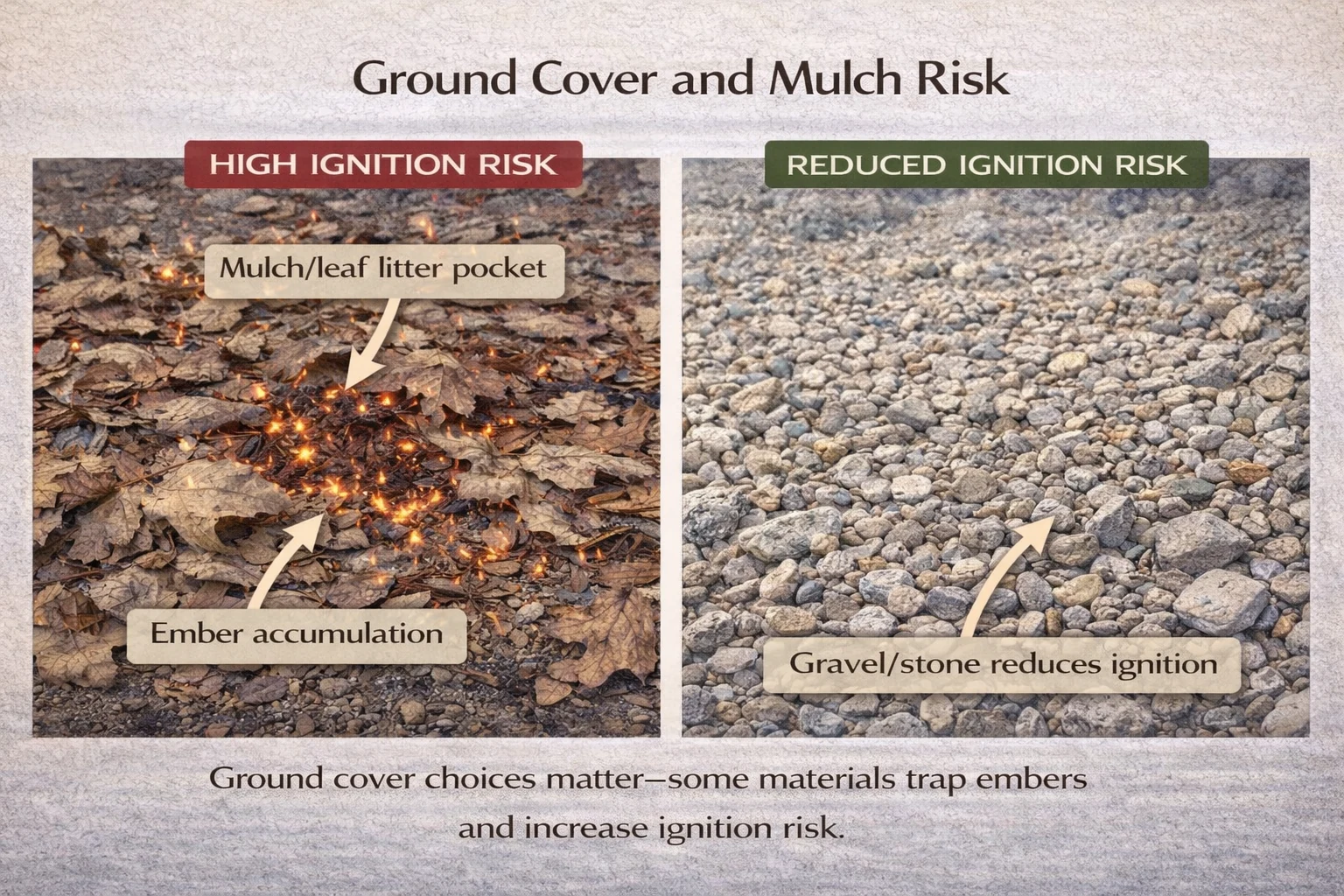
Ground and surfaces
- No combustible materials: fallen leaves and needles, combustible mulch including bark and wood chips, debris. (A temporary exception for erosion-control mulch during construction or emergencies.)
- Roof and gutters clear of leaves and needles.
- Nothing combustible under decks, balconies, pergolas, or stairs.
- No firewood.
Plants
- No vegetation under the eaves, within 1 foot of a wall with no eave, within 5 feet of an attached deck, stairs, or pergola, or within 2 feet of windows, doors, vents, or structural posts.
- Elsewhere in the 5 feet: non-woody plants under 3 inches tall (lawn, groundcover) are fine. Non-woody plants 3–18 inches tall are allowed in plantings of one square foot or less, spaced 1.5 times their height apart. Potted non-woody plants up to 18 inches in unattached noncombustible pots of 5 gallons or less.
- Nothing woody. No shrubs.
Trees
Trees may remain in Zone 0 if:
- No dead or dying branches.
- Live branches at least 10 feet from a chimney or stovepipe outlet.
- No live branches under the eaves.
- Ladder fuels removed: lower branches up to 6 feet, or the lower third of the tree's height, whichever is less; and all fuels within 5 feet above the roof.
- Live branches at least 5 feet above the roof and at least 1 foot from a wall with no eave.
The September 2026 guidance document adds that no new trees may be planted in Zone 0 once the rule is effective.
Fences, gates, outbuildings
- No combustible fence or gate attached to the structure. Where a fence attaches or comes within 1 foot, a 5-foot noncombustible span.
- No new combustible fences or gates within 5 feet. Repairs to existing ones allowed.
- Outbuildings in Zone 0 only if entirely noncombustible.
The phase-in for existing homes
| Timing (from effective date) | What |
|---|---|
| Immediately | Roof and gutters clear; dead branches off; 10 ft chimney clearance; no branches under eaves |
| Within 3 years (Phase 1) | Combustible mulch and materials out; nothing under decks; firewood out; ladder fuels removed; branches 5 ft above roof |
| 3 years, or up to 5 if the local agency sets a timeline (Phase 2) | Vegetation-free buffers at walls, eaves, decks, openings; fence and gate changes; outbuildings |
| New construction | Everything, on the effective date |
Local fire agencies could approve alternatives on a finding that they are equally effective.
The protected-tree problem, again
The draft lets trees stay — but only pruned to its standards. In the Bay Area the tree in Zone 0 is often a coast live oak, a redwood, or a heritage-size anything, and the city regulates pruning as well as removal. Oakland's draft guidance says locally protected trees may be exempt from some requirements. The practical path: prune to the Zone 0 standard where the city allows it without a permit (deadwood and minor clearance almost always qualify), get an arborist's written statement that the tree meets the standard or can't, and use that statement with both the city and the insurer. Where the tree can't be made to work, the arborist report is what the city needs to approve removal. Permits by city →
What to do now
- Do the cheap parts this season. Mulch to gravel in the 5 feet. Nothing under the deck. Firewood moved to Zone 2. Gutters and roof cleared. Dead branches off. Every one of these is a Safer from Wildfires insurance credit today and an inspection item in Oakland, Berkeley, Marin, and Woodside already.
- Prune the trees to the draft standard. Chimney clearance, under-eave branches, limb-up, roof clearance. Mostly permit-free; confirm on your city page.
- Hold the expensive, irreversible items — replacing fences, removing a tree you want to keep — until the rule is refiled, unless your insurer or city is requiring it now.
- Document it. Dated photos of each item. If you want the professional statement for an insurer, that's the Insurance Documentation Package.
This page will be updated when the Board refiles. The date at the top is the last check.
Sources
- Board of Forestry — Defensible Space Zones 0, 1 and 2
- Board of Forestry — Zone 0 regulation summary and rule text, August 2026 (14 CCR §1298.04 / §1299.03)
- Board of Forestry — Zone 0 Guidance Document, September 2026
- Office of Administrative Law — recent actions on emergency regulations (withdrawn Sept 8, 2026)
- AB 3074 chaptered text
- CAL FIRE Ready for Wildfire — Defensible Space (Zone 0 "not legally required yet")
- Oakland Fire — Zone 0
Questions we get
Is Zone 0 required right now?
No. The statute (PRC §4291 via AB 3074) says the 0–5 ft ember-resistant zone takes effect only after the Board of Forestry adopts regulations. The Board adopted emergency regulations on August 19, 2026, filed them with the Office of Administrative Law on August 28, and withdrew them on September 8. Nothing has been refiled as of October 20, 2026. CAL FIRE's own guidance says Zone 0 is 'not legally required yet.' Local agencies like Oakland Fire say they will not enforce until the state rule is final.
Will I have to remove the trees next to my house?
Under the adopted-then-withdrawn text, no. Trees can stay in Zone 0 if they are deadwooded, limbed up, kept 10 feet from a chimney, kept out from under the eaves, held 5 feet above the roof, and have no ladder fuels beneath them. New trees could not be planted in Zone 0. Protected trees that can't be pruned to those standards are the hard cases, and that's a city permit conversation.
Does Zone 0 apply to my city?
The draft applies in the State Responsibility Area and in Very High Fire Hazard Severity Zones in local areas. If the 2025 maps put you in a High zone rather than Very High, the state rule would not reach you — but your city's own ordinance, your insurer, and IBHS might.
What about mulch?
No combustible mulch — bark, wood chips — in the 5 feet. Gravel, rock, pavers, concrete, or bare soil. Composted or rubber mulch doesn't qualify as noncombustible. This is also a Safer from Wildfires insurance item, so it's worth doing regardless of the rule's status.
What's the phase-in for existing homes?
Under the withdrawn draft: roof and gutter clearing, dead branches, chimney clearance, and branches under eaves — immediately on the effective date. Mulch, combustibles, under-deck storage, firewood, ladder fuels, and the 5-feet-above-roof rule — within 3 years. The vegetation-free buffer at walls, fences, and outbuildings — 3 years, or up to 5 if the local agency sets a longer timeline. New construction would comply immediately.
Should I do Zone 0 work now or wait?
Do the cheap, reversible parts now: mulch to gravel, nothing under the deck, firewood moved, gutters cleared, dead branches off. They're insurance credits today and inspection items in most Bay Area districts already. Wait on anything expensive and irreversible that depends on the final text — fence replacement, removing a tree you like — until the rule is refiled, unless your insurer or city is requiring it now.