

Trees and wildfire: species, spacing, and the keep-or-remove call
 By Michael Schuck, ISA Certified Arborist WE-15750A · Updated 2026-10-20
Plants the fire agencies say to remove
Fire Safe Marin's fire-prone list, Berkeley's 2026 EMBER landscape guide, UC ANR, and Larkspur's codified fire-prone tree list overlap almost completely. The Bay Area consensus, with what each agency says:
| Plant | Why | What the agencies say |
|---|---|---|
| Juniper (all forms) | Resinous, dense dead interior, ignites from a single ember | Fire Safe Marin: remove within 30 ft of structures and 15 ft of driveways. Moraga-Orinda Fire: remove within 10 ft of roads and driveways by ordinance. Larkspur: fire-prone list. |
| Italian cypress, arborvitae (Thuja), yew | Column of fine dead foliage; torches | Fire Safe Marin "Roman candles," remove in the WUI. Berkeley recommended Zone 1 removal. |
| Bamboo | Dead culms and leaf litter, impossible to keep clean | Fire Safe Marin: unsuitable near homes. San Rafael and Southern Marin Fire run removal programs for it. |
| Pampas and jubata grass, fountain grass | Dead blades year-round; ember catcher | Every list. Invasive as well. |
| Scotch, French, Spanish broom; gorse | Oily, dense dead stems; invasive | Every list. MOFD lends broom pullers. |
| Acacia | Oily foliage, heavy litter, dieback | Fire-prone everywhere. Unprotected or fast-tracked in San Anselmo, Fairfax, Sausalito, Novato, Belmont, and Scotts Valley; protected at 9 inches in Oakland. |
| Eucalyptus (blue gum especially) | Oil, shedding bark, long-distance embers | Fire-prone everywhere; Berkeley has a one-time eucalyptus cleanup in its assistance program; Santa Cruz County has an over-the-counter removal path. Unprotected in Oakland, Lafayette, San Carlos, Sausalito, Scotts Valley; expedited in Saratoga and Fairfax. |
| Pines (Monterey, Bishop, others), Douglas fir, spruce, cedar, cypress | Resin, needle litter, pitch-canker dieback in Monterey pine | Fire Safe Marin fire-prone by genus. MOFD bans Monterey pine within 5 ft of structures. Woodside Fire's "flammable five": eucalyptus, pine, acacia, juniper, cypress. |
| Rosemary (large hedges) | Oily, dense dead wood inside | Fire Safe Marin and Berkeley lists. Small, irrigated, pruned specimens outside Zone 0 are tolerated. |
| Palms with dead fronds | The frond skirt is an ember torch | Fire Safe Marin. Skirt removed annually or the tree goes. Unprotected in Lafayette, Scotts Valley; auto-issued in Belmont. |
| Chamise, coyote brush, sagebrush, black sage, twiggy manzanita | Native chaparral; fine at distance, not against a house | Fire Safe Marin fire-prone list. Keep out of Zones 0–1; thin and space in Zone 2. |
The native trees, one at a time
Coast live oak
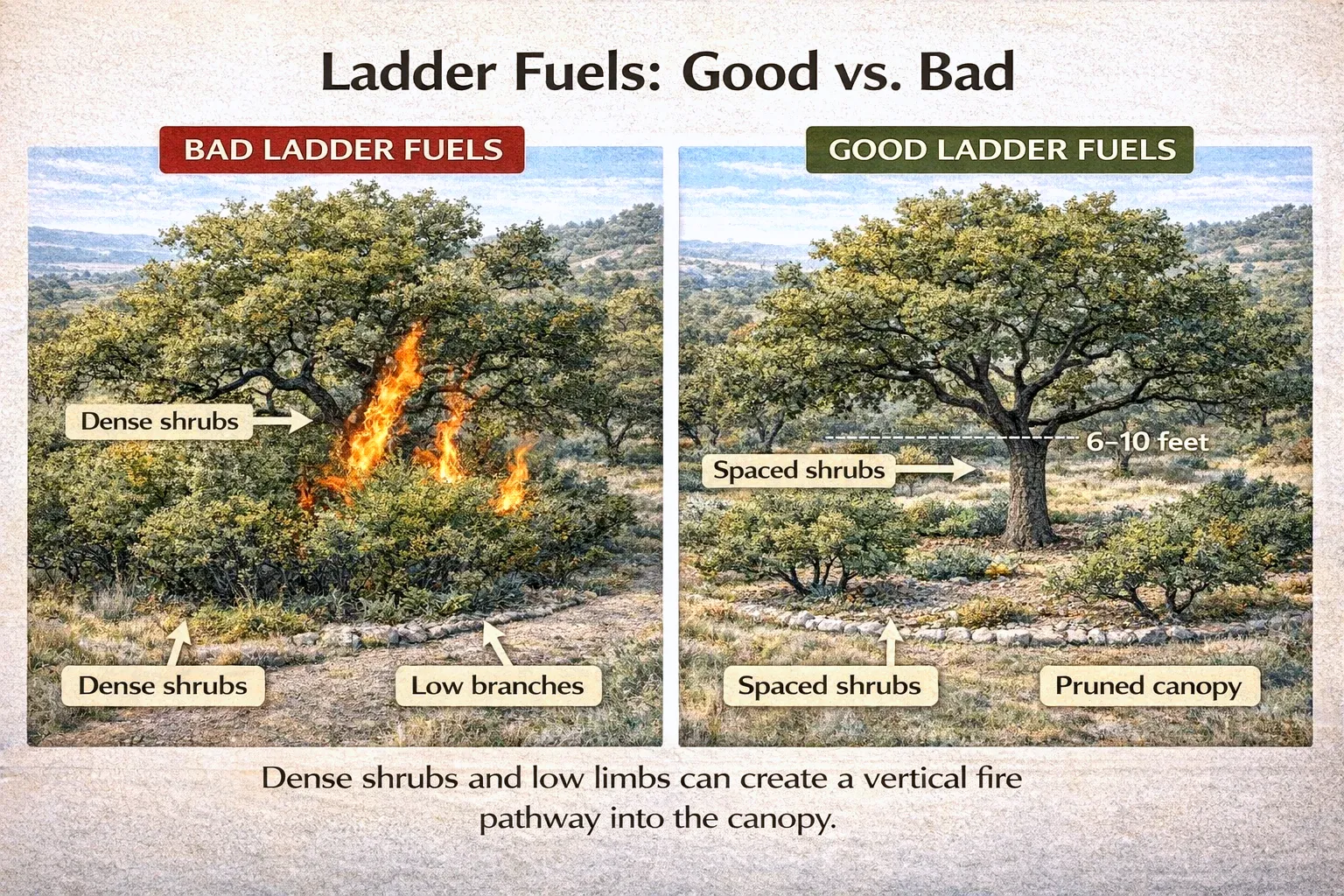
On the fire-resistant lists (Fire Safe San Mateo, Berkeley's recommended natives, Napa's valued natives). Thick leaves with moderate moisture, not resinous. The failure mode is neglect: interior deadwood, a skirt of branches to the ground, and shrubs beneath. Fix those and the oak is a shade structure that slows wind and catches embers in a crown that doesn't torch. Protected in nearly every Bay Area city — Oakland at 4 inches, Berkeley at 18 inches circumference, Marin County at 6 inches — so the answer is almost always prune, not remove.
Coast redwood
Fire-resistant on irrigated or riparian sites; bark 6–12 inches thick on mature trees; an approved Oakland replacement species. Problems are drought stress (dead tops, interior browning), litter depth, and the shredded-bark mulch sold under its name — Fire Safe Marin strongly discourages "gorilla hair." Keep it watered through summer, deadwood it, limb it up, rake Zones 0–1. Protected at 10 inches in Marin County, 95 inches circumference in Mill Valley, 54 inches in Portola Valley.
Madrone
Fire-resistant (Fire Safe San Mateo, Oakland replacement list); not on Marin's fire-prone list. Shedding bark and leaf litter need raking. Protected at 6 inches in Marin County, 24 inches circumference in Portola Valley.
California bay laurel
The honest answer is "both." Fire Safe Marin lists it as fire-prone — oily foliage, heavy litter. Oakland lists it as a replacement species; Berkeley lets mature trees stay in Zone 0; Scotts Valley exempts bay under an oak's drip line. Keep existing bays maintained and off the structure; don't plant new ones within 30 feet; rake. Protected at 10 inches in Marin County, 36 inches circumference in Portola Valley.
Douglas fir, Monterey pine, Monterey cypress
Fire-prone by genus on Fire Safe Marin's list. Lafayette excludes Douglas fir from protection; Sausalito, Tiburon, and Fairfax classify Monterey pine and cypress as undesirable; Saratoga says Monterey pine removal in the WUI "may always be granted." A healthy, isolated specimen 30 feet out with litter control is tolerable. A declining one over the roof is the first removal on the list.
Olive and citrus
Citrus is on Fire Safe Marin's and Napa's fire-resistant lists — high moisture, low resin. Olive is on Napa's fire-wise ornamental list; no CAL FIRE statement either way. Both are fine in Zone 1 if irrigated and kept clean of dead wood; olive litter needs raking.
Spacing and clearance numbers
| Rule | Number | Source |
|---|---|---|
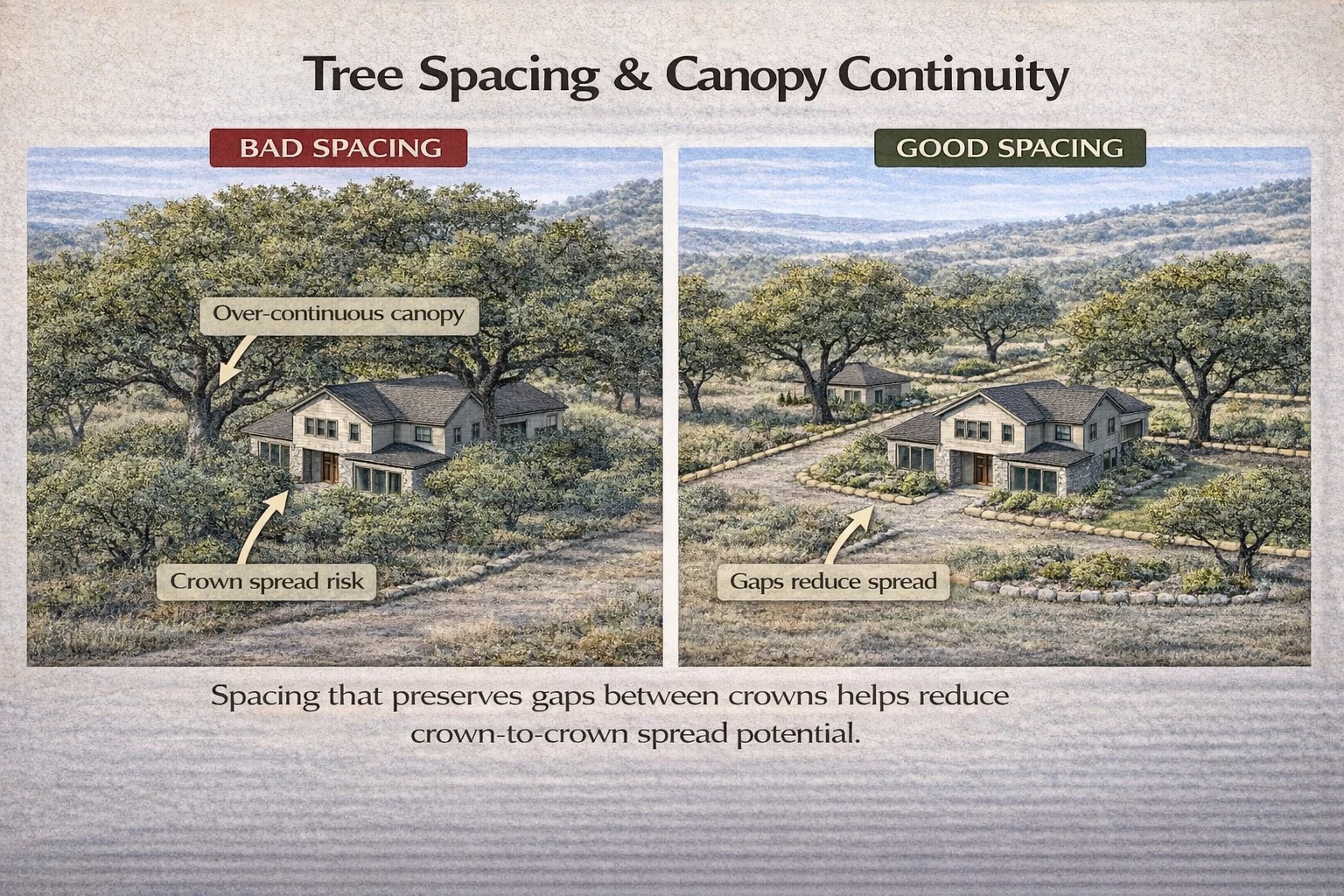
| Crown separation, slope under 20% | 10 ft | CAL FIRE; Berkeley; Oakland WUI 604 |
| Crown separation, 20–40% slope | 20 ft | CAL FIRE |
| Crown separation, over 40% slope | 30 ft | CAL FIRE |
| Shrub spacing by slope | 2× / 4× / 6× shrub height | CAL FIRE |
| Limb-up height | 6 ft, or ⅓ of height (Oakland: ¼) on small trees | CAL FIRE; Oakland |
| Shrub-to-canopy vertical gap | 3× shrub height | CAL FIRE |
| Chimney or stovepipe outlet | 10 ft — in the statute | PRC §4291(a)(2) |
| Roofline | 10 ft (Oakland); 5 ft above roof (Berkeley Zone 0; withdrawn state Zone 0 draft) | Oakland WUI 604; Berkeley; BOF Aug 2026 text |
| Dead and dying wood on trees over or adjacent to the building | Removed — in the statute | PRC §4291(a)(3) |
| Road and driveway vertical clearance | 13 ft 6 in | Berkeley |
Mulch
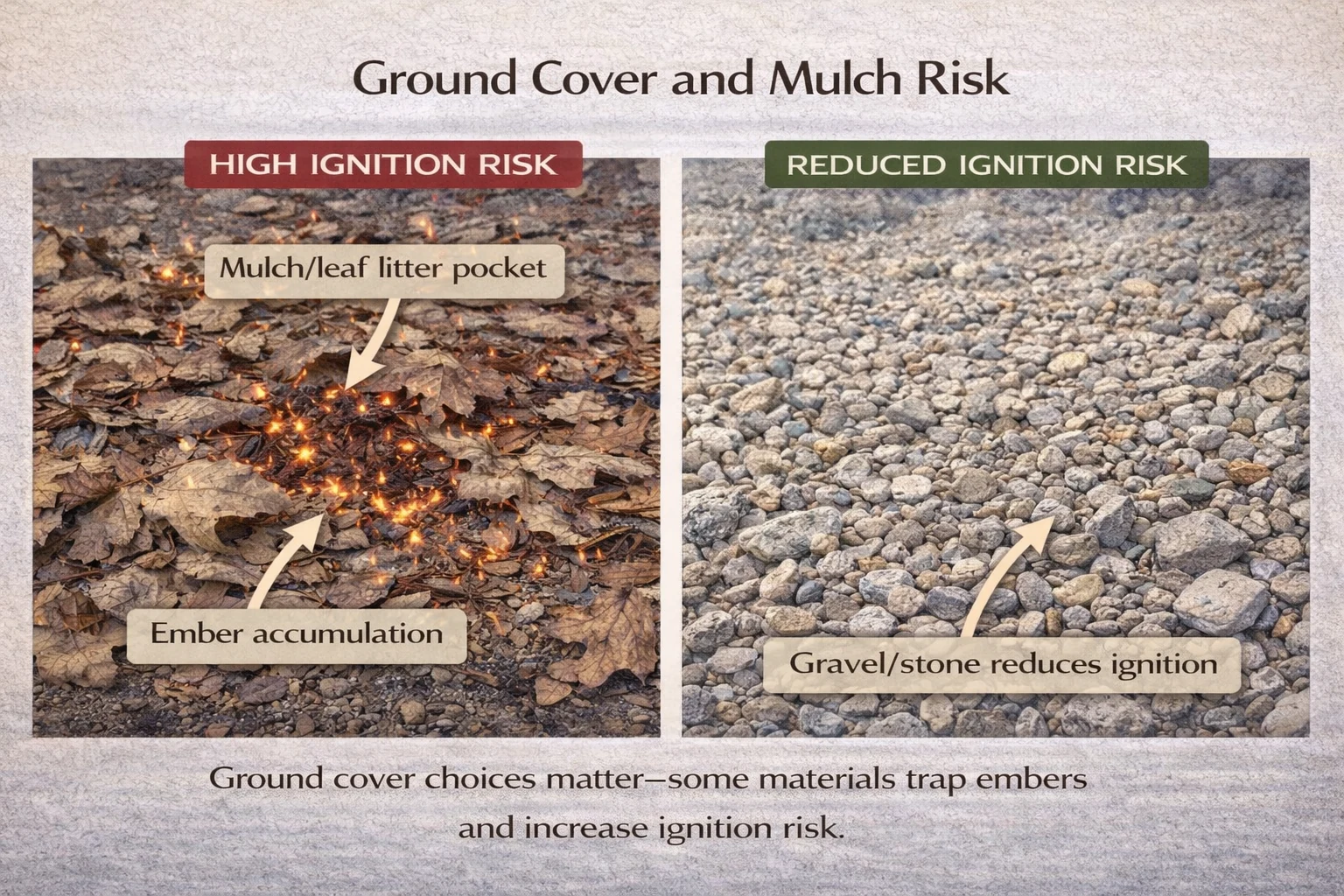
- Zone 0: nothing combustible. Gravel, decomposed granite, pavers, concrete, bare soil. This is CAL FIRE guidance, the withdrawn state Zone 0 text, Berkeley's EMBER ordinance, Woodside Fire's Ordinance 24-01, and a Safer from Wildfires insurance item.
- Zones 1–2: the University of Nevada Reno / UC study (Quarles & Smith) ranked composted wood chips least hazardous and shredded rubber, pine needles, and shredded cedar most. Fire Safe Marin: composted chips in small patches alternating with noncombustible breaks; no pine needles within 30 feet; no gorilla hair. Oakland allows chips up to 12 inches deep on slopes in Zones 1–2.
Keep or remove: how the call gets made on a site visit
- Dead or more than half dead? Remove. Exempt or over-the-counter almost everywhere.
- High-hazard species touching or over the structure? Remove. Usually unprotected or expedited; check the permits table.
- Protected species with a clearance or ladder-fuel problem? Prune to the numbers above. Permit-free in most cities for deadwood and minor clearance; document it for the insurer.
- Crowns so entangled that 10 feet of separation can't be made by pruning? Thin — remove the weakest or the non-native — with an arborist report written to the city's criteria.
- Structural defects — lean toward the house, cracks, decay at the base, lifted roots? That's a hazard question, not a fire question, and it gets its own assessment.
That judgment is the product. A site consultation is $375; the Defensible Space Plan ($850) puts every tree within 30 feet in a table with species, condition, action, and permit status.
Sources
- CAL FIRE — Defensible Space (spacing, limb-up, chimney clearance)
- Fire Safe Marin — Plants · Fire Safe Marin fire-prone and fire-resistant plant list · Fire Safe Marin — Mulches
- Berkeley Fire — FireSafe Berkeley Landscape Guide (2026)
- Oakland Fire — Compliance standards for vegetation inspections (WUI 604)
- Fire Safe San Mateo — Fire-resistant plant list
- UC Marin Master Gardeners — Fire-safe planting · UC ANR — Firesafe landscaping · UC Napa — Fire-wise plant list
- University of Nevada, Reno — mulch combustibility study (Quarles & Smith)
- Larkspur Municipal Code 12.16 — fire-prone tree definition · Moraga-Orinda Fire Ordinance 23-03
Questions we get
Are coast live oaks a fire hazard?
Not as a species — they're on the fire-resistant lists from Fire Safe San Mateo and Berkeley's EMBER guide. UC Marin's caveat is the one that matters: a neglected oak with interior deadwood and a canopy to the ground ignites easily. Deadwood it, limb it up, clear the shrubs beneath, keep it 10 feet off the chimney, and it's an asset.
Should I remove the redwoods near my house?
Usually no. Coast redwood is on fire-resistant lists for irrigated sites and is an Oakland-approved replacement species; its bark is thick and its foliage holds moisture when watered. Sausalito and Tiburon call it 'undesirable' for its growth rate, not flammability. Keep it irrigated, deadwooded, and limbed up; keep litter raked in Zones 0–1; and don't use shredded redwood bark ('gorilla hair') as mulch anywhere near the house.
Which plants should come out first?
Juniper within 30 feet of the house and 15 feet of the driveway. Then Italian cypress, bamboo, broom, pampas grass, and any acacia or eucalyptus touching or over the structure. These are on every Bay Area fire agency's list and several cities exempt them from permits — see the permits table.
How far apart do trees need to be?
CAL FIRE: 10 feet between crowns on slopes under 20%, 20 feet on 20–40%, 30 feet above 40%. Limb up 6 feet (or a third of the height on small trees). Vertical gap between the top of a shrub and the lowest branch above it: three times the shrub's height. Nothing within 10 feet of a chimney. These are guidance in the SRA and code in Oakland (WUI 604) and Berkeley.
Is bay laurel a problem?
It's on Fire Safe Marin's fire-prone list — oily leaves, heavy litter — but it's also an Oakland replacement species and counts as a 'mature tree' Berkeley lets stay in Zone 0. Keep it, don't plant it near structures, rake the litter in Zones 0–1, and keep ladder fuels out from under it.
What mulch can I use?
Zone 0: none that's combustible — gravel, decomposed granite, pavers. Zones 1–2: composted wood chips in small patches with noncombustible breaks were the least hazardous in the UNR/UC study; shredded rubber, pine needles, and shredded cedar or redwood bark were the worst. Oakland allows chips up to 12 inches deep on slopes in Zones 1–2.