

When the fire hazard is on your neighbor's property
 By Michael Schuck, ISA Certified Arborist WE-15750A · Updated 2026-10-25
Dispute reports are handled under Boundary Tree, the same arborist's neighbor-dispute practice. This page explains the law and the sequence first.
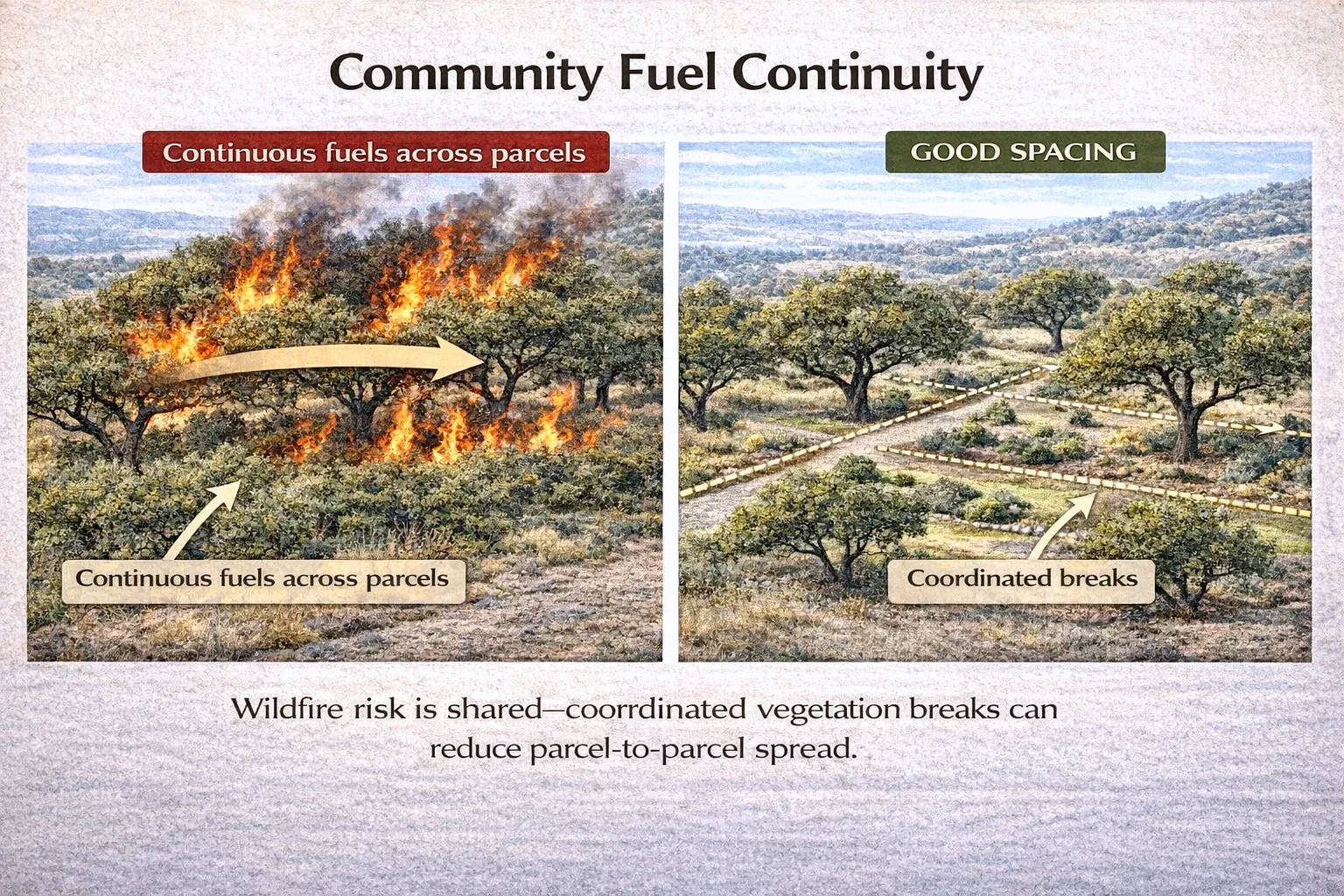
The three situations
- The canopy over your roof is rooted next door. A eucalyptus, Monterey pine, or redwood on their lot with branches within 10 feet of your chimney or 5 feet of your roof — the exact things your inspector and insurer flag.
- The ladder fuel is on their side of the fence. Juniper, bamboo, broom, or a dead tree inside 30 feet of your house but across the line. Your Zone 1 is clean; theirs isn't.
- The tree is on the line. A boundary oak or bay the inspector wants limbed up, that neither of you can touch without the other.
What the law actually gives you
- Ownership follows the trunk (Civil Code §833). If the trunk stands entirely on their land, it's their tree, however much canopy is over yours.
- Line trees are owned in common (§834). Removal or major pruning of a trunk on the line needs both owners.
- You can cut what crosses the line — carefully. Encroaching branches and roots may be trimmed back to the line at your expense. But Booska v. Patel (1994) ended the old "cut to the line no matter what" rule: you're liable for damage to the tree, and a tree injured by bad pruning can mean treble damages under Civil Code §3346. The fix for a fire-clearance problem is a specified cut, not a saw at the fence.
- Defensible space ends at the line. PRC §4291(a)(1) and Gov. Code §51182: "not beyond the property line." Your legal duty is your parcel; so is theirs.
- Spite-fence law can reach dense plantings. Civil Code §841.4 treats a fence or hedge over 10 feet maintained to annoy a neighbor as a nuisance; a row of Italian cypress between houses sometimes qualifies.
- Nuisance (Civil Code §3479) and negligence cover a known hazard a neighbor refuses to abate — a dead tree leaning toward your house is the clearest case.
What the fire district will do
Bay Area fire agencies inspect parcel by parcel against their own standard, and they take complaints. What that gets you, and doesn't:
| Agency | What a neighbor complaint triggers | Limit |
|---|---|---|
| Oakland Fire Vegetation Management | Inspection of the named parcel; notice with a 45-day correction window; re-inspection fees; lien as last resort | Enforces Oakland's WUI 604 standard; can't require removal of a protected tree |
| Berkeley Fire WUI Division | Inspection in mitigation areas and the Very High zone; Zone 0 enforced since May 2026 | Mature trees exempt from Zone 0 removal; oak ordinance still applies |
| Marin districts via MWPA | Evaluation and Wildfire Risk Report for the parcel; enforcement by the local district | Each town's tree ordinance governs what the neighbor can actually remove |
| Woodside Fire | Assessment under Ordinance 24-01; 12 months to comply; citations | Woodside's significant-tree permit still required for removals |
| CAL FIRE (SRA) | PRC §4291 inspection of the parcel | Clearance, not removal; no authority over local tree permits |
The gap: the district enforces its vegetation standard. Your insurer's letter may ask for more — 10 feet of crown separation, a species removed — than the district requires. A complaint gets the neighbor to the district's line; the insurer's line is a negotiation, and negotiation runs on documentation.
The sequence that works
- Get the requirement in writing. The inspection notice or the insurer's letter, naming the tree and the distance. Vague "defensible space concerns" don't move anyone.
- Get an independent report. An arborist with no stake in either yard documents the tree, the hazard, the applicable code, and the least-invasive fix — often pruning to clearance rather than removal, which is what makes neighbors say yes. If the tree is protected, the report also says what the city will permit.
- Ask in writing, with the report attached. A short letter, a copy of the report, a reasonable deadline, and an offer to share cost for work on their side that benefits you. Most disputes end here.
- Use the district if they refuse. File the complaint with the report attached; inspectors act faster on a documented hazard.
- Mediate before you sue. Every Bay Area county has a community mediation program for neighbor disputes; the report is the exhibit. Small claims (up to $12,500) or a nuisance action if it goes further — expert witness time is $250/hr.
Don't
Don't cut past the line. Don't top the neighbor's tree from your side. Don't hire a crew to "just handle it." Each of those converts a hazard you can document into damages you owe.
Where Boundary Tree comes in
Neighbor disputes are a different job from a defensible space plan — the audience is the neighbor, a mediator, or a judge, and the report has to be independent to be worth anything. That work is done under Boundary Tree, the same arborist's dispute practice: Dispute Assessment Report from $850, desk review from photos and letters $250, neighbor letter add-on $150, court time $250/hr. Same phone number, same rule — consulting only, nothing sold or referred.
Start a Boundary Tree report Boundary Tree services & pricing
If your own side of the line needs work too, the Defensible Space Plan covers your parcel and flags the neighbor-side items for the Boundary Tree report in one visit.
Sources
- Civil Code §833 · §834 · §841.4 · §3346 · §3479
- Booska v. Patel, 24 Cal.App.4th 1786 (1994)
- PRC §4291 · Government Code §51182
- Oakland Fire — Wildfire District Inspections · Berkeley Fire — inspections · Woodside Fire — home assessments
- Boundary Tree — California neighbor tree law
Questions we get
Can I cut my neighbor's branches that hang over my yard?
Yes, up to the property line, at your own expense — and only if it doesn't damage the tree. California courts (Booska v. Patel, 1994) hold you liable for harm to the tree even for cutting on your side, so topping a neighbor's redwood at the fence line to get 10 feet off your roof is a lawsuit, not a fix. Get an arborist to specify a cut that meets the fire standard without injuring the tree.
Who owns a tree on the property line?
Both of you, jointly (Civil Code §834). Neither owner can remove it or do major work without the other's consent. A tree whose trunk is entirely on one side belongs to that owner (§833), even if most of the canopy is on yours.
Can the fire department make my neighbor clear their brush?
In most Bay Area districts, yes — the neighbor's parcel gets inspected to the same standard, and you can file a complaint. Oakland, Berkeley, the Marin districts, and Woodside Fire all take neighbor complaints. What they enforce is their vegetation standard, not your insurer's letter; the gap between those two is where an independent report helps.
My insurer says the neighbor's tree has to go or I'm non-renewed. Now what?
Three steps: get the insurer's requirement in writing with the specific tree and distance; get an independent arborist report stating the hazard, the code, and the least-invasive fix; send both to the neighbor with a written request. Most neighbors act on a third-party report. If they don't, the report is the foundation for the fire district complaint, mediation, or small claims.
Does defensible space law let me clear 100 feet onto the neighbor's land?
No. PRC §4291 and Government Code §51182 both say 'not beyond the property line.' Your obligation ends at the fence; theirs starts there. You have no right to enter or clear their land, even for fire safety.
What does the Boundary Tree report cost?
Dispute Assessment Report from $850; a desk review from photos and letters $250; a neighbor letter on arborist letterhead $150 as an add-on. Expert witness time $250/hr if it goes further. It's the same arborist as this site, under the practice built for disputes.